Pillar guide
What is Agentic AI?
Agentic AI systems pursue goals by planning, using tools, observing results, and iterating—unlike single-turn chatbots or fixed workflows.
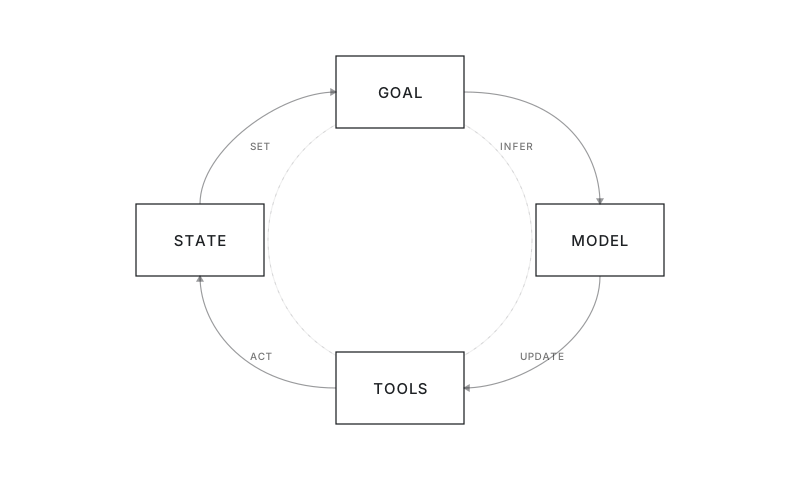
Agentic AI refers to systems that pursue goals by deciding what to do next: planning steps, calling tools or APIs, observing results, and iterating until the task is complete, fails, or is halted by a policy.
That is the practical definition used across engineering teams. Marketing blur can be ignored; the test is behavioral.
A practical definition
An agentic system typically combines:
- A goal expressed by a user, another system, or a schedule
- A reasoning model (usually an LLM) that proposes the next action
- Tools — code, browsers, databases, tickets, email, MCP servers, etc.
- A control loop that executes actions, records outcomes, and continues
- Stopping conditions — success criteria, max steps, human approval, or safety blocks
If any of those are missing, you may still have valuable AI—but it may not be agentic.
What agentic AI is not
| Concept | How it differs from agentic AI |
|---|---|
| Chatbot | Answers in conversation; no durable multi-step tool loop by default |
| RAG Q&A | Retrieves context and responds once; retrieval is not the same as autonomous action |
| Fixed workflow / DAG | Steps and branches are pre-authored; the model may fill fields but does not own the plan |
| Script / RPA bot | Deterministic automation; no open-ended model-driven decision making |
| Copilot autocomplete | Assists a human in-place; the human remains the primary controller |
Related deep dive: Agentic vs chatbots vs workflows.
A minimal agent loop
Most production agents are variants of this loop:
while not done and steps < max_steps:
  context = observe(state, memory, tools_results)
  decision = model.decide(goal, context)   # plan, act, or finish
  if decision.type == "tool":
    result = execute(decision.tool, decision.args)
    state = update(state, result)
  elif decision.type == "finish":
    return decision.answer
  elif decision.type == "ask_human":
    return escalate(decision.question)
Classic patterns such as ReAct and plan-and-execute are structured ways to implement this loop.
Levels of agency (a useful spectrum)
Agency is not binary. Teams ship systems at different levels:
- Tool-augmented response — one model turn may call tools, then answer
- Multi-step agent — loops until done, with retries and intermediate memory
- Orchestrated multi-agent — specialized agents collaborate under a graph or manager
- Long-running agent — works across sessions, calendars, inboxes, or tickets with durable state
Higher levels increase capability and failure surface area (cost, security, non-determinism).
Why agentic AI matters now
Three shifts made agentic systems practical:
- Reliable tool calling in frontier models
- Better context and memory patterns for multi-step tasks
- Protocols and frameworks (function calling, graph orchestrators, MCP) that standardize how models reach software
The result: software that can operate, not only explain.
Capabilities that look agentic
Common product surfaces:
- Research agents that browse, summarize, and cite
- Coding agents that edit repos, run tests, and open PRs
- Support agents that read tickets, query CRM, and draft resolutions
- Ops agents that investigate alerts and propose remediations
- Data agents that query warehouses and produce analyses
Each still needs evaluation and guardrails.
Design criteria: is your system agentic enough?
Use this checklist:
- Can it choose among tools rather than always following one path?
- Does it observe intermediate results before the final answer?
- Are there explicit stop conditions (success, budget, policy)?
- Can you inspect the trajectory (steps, tool I/O, errors)?
- Do you measure task success, not only next-token quality?
If most answers are “no,” start with a workflow plus LLM steps before introducing open-ended agency.
Benefits and costs
Benefits
- Handles messy, multi-system tasks
- Reduces hand-written branching for unknown paths
- Scales knowledge work that previously required humans in the loop for every micro-decision
Costs and risks
- Higher and less predictable latency and token spend
- Harder debugging when plans diverge
- Security exposure via tool permissions
- Partial or confident-but-wrong completion
Agentic AI is a systems problem, not a prompt-only problem. Architecture details live in Agentic architecture.
Glossary-grade summary
Agentic AI: AI systems that pursue goals through iterative decision-making, tool use, and observation, with limited human intervention between steps.
Next reading
FAQ
Frequently asked questions
What is agentic AI in one sentence?
Agentic AI is software that uses a model to pursue a goal by choosing actions, calling tools, observing outcomes, and continuing until the goal is met or stopped.
Is ChatGPT an agent?
A plain chat interface is not an agent. Chat becomes agentic when the system can plan multi-step work, use tools or APIs, and loop on intermediate results with limited supervision.
What makes a system agentic rather than just automated?
Automation follows a pre-specified path. Agentic systems adapt the path: they decide which tools to call, when to stop, and how to recover from intermediate failures.
When should you not use agentic AI?
Avoid agents when the steps are fully known, latency and cost must be predictable, or you need strict auditability with no model-driven branching.